
Google AI Overviews for Professional Services: How B2B Firms Become a Source
Search results are changing. Instead of showing only links, Google increasingly generates AI answers that cite websites as sources. This article explains why some professional services websites appear in those answers — and others never do.
B2B SEO for Professional Services — Article Series
This article is part of our B2B SEO for Professional Services series,
where we break down real SEO strategies used for EU professional service firms.
Articles in the series:
Google AI Overviews for Professional Services: Why AI answers are changing professional services SEO
Google increasingly generates answers directly on the search results page.
These answers often cite several websites as sources.
How to appear in ai overviews? For professional services — accounting, tax, legal, compliance — this change is important.
In many cases the AI answer appears before traditional search results.
That means users may see an explanation before they ever click a link.
This raises a practical question for business owners:
AI search optimization: Why do some professional services websites appear inside AI answers while others never do?
To answer that, we need to understand how AI systems decide which websites are reliable enough to reference.
TL;DR
Google AI Overviews usually cite websites that demonstrate three things:
- clear expertise
- structured answers
- consistent topic coverage
In our case study these signals came from:
- service-first site architecture
- multilingual demand coverage
- consistent professional services content
Example query
“Do accounting firms appear in Google AI Overviews?”
Short answer:
Yes — when websites demonstrate structured expertise and consistent topic coverage.
Professional services websites with clear architecture and reliable information are more likely to be cited as sources.
AI overview citation. A simple analogy: AI as a journalist
A simple way to understand AI citations is to imagine a journalist writing an article.
Journalists do not quote random websites.
They reference sources that appear reliable and knowledgeable.
Google’s AI systems operate in a similar way.
When generating an answer, they select sources that demonstrate consistent expertise.
What signals make a website easier for AI to cite
1. Clear expertise in one domain
Professional services require trust.
Websites that consistently focus on a specific domain — such as accounting or corporate services — provide clearer signals than sites publishing unrelated topics.
2. Structured explanations
AI systems prefer pages that clearly answer questions.
Examples include:
- definitions
- step-by-step explanations
- tables
- FAQ sections
These elements make it easier for search systems to extract information.
3. Consistent topic coverage
Another common pattern is topic clusters.
When multiple pages consistently cover related aspects of a professional topic,
Google receives stronger signals about the site’s expertise.
This is exactly why this article is part of the B2B SEO for Professional Services series.
Example AI Overview citing a professional services website as a source.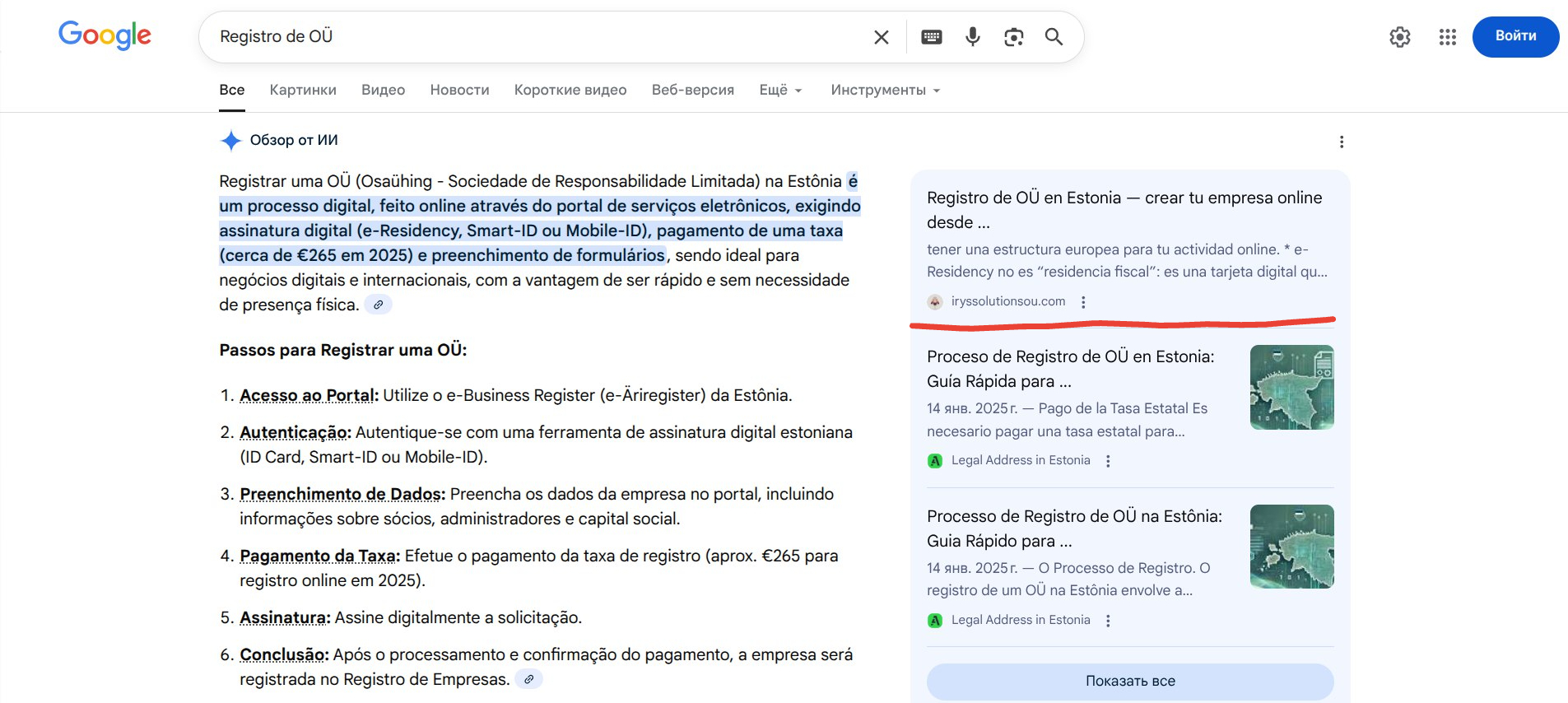
This screenshot shows a Google AI Overview where the client website appears among cited sources.
The citation demonstrates that the page is used to construct the AI answer.
Professional services search visibility. Why most professional services sites never appear in AI answers
Many websites never receive AI citations simply because their structure does not demonstrate expertise clearly enough.
Common issues include:
- generic blog content unrelated to services
- weak service page structure
- thin or duplicated content
- inconsistent topic coverage
In regulated industries such as accounting and legal services,
these weaknesses are especially problematic.
The practical framework
Step 1 — Build service-first architecture
Services should be the center of the website.
Informational content should support those services rather than replace them.
Step 2 — Expand real demand
Multilingual SEO for professional services expands demand across EU markets.
However languages must match user intent rather than simply duplicating pages.
Step 3 — Build topic clusters
Multiple articles covering related aspects of the same topic create stronger authority signals.
Search engines recognize that the site consistently publishes expertise in a specific domain.
If you sell professional services in the EU:
Send us your niche, target markets and current site languages.
We will reply with a practical 30-day B2B SEO roadmap.
💬 Request the roadmap (WhatsApp)
Contact page
Continue the series
- Article 1 — Real B2B SEO Case Study
- Article 2 — Service-First Architecture
- Article 3 — Multilingual SEO
- Article 5 — Building Topical Authority