

B2B SEO for Professional Services — Article Series
This article is part of our B2B SEO for Professional Services series,
where we break down real SEO strategies used for EU professional service firms.
Articles in the series:
Case Study ·
SEO Architecture ·
Multilingual SEO
How We Ranked an Estonian B2B Accounting Firm in 3 Languages and Entered Google AI Overviews — A Real Case Study
This is not a “tips” post. It’s a measured breakdown of what was built, why it worked, and what Google actually rewarded.
If you sell professional services (accounting, tax, legal, compliance) and want qualified leads — this framework is the baseline.
Client disclosed (real brand, real domain)
Client: Irys Solutions (Estonian accounting & corporate services).
We can publicly reference and link the client domain as part of this case study.
Visit client website.
TL;DR
We built a service-first content architecture (not random blog posts), mapped multilingual search intent (EN/RU/ES),
and structured the site so Google can treat it as a reliable source in a regulated niche.
Result: commercial-query visibility and multiple AI Overview appearances where the site is cited as a source.
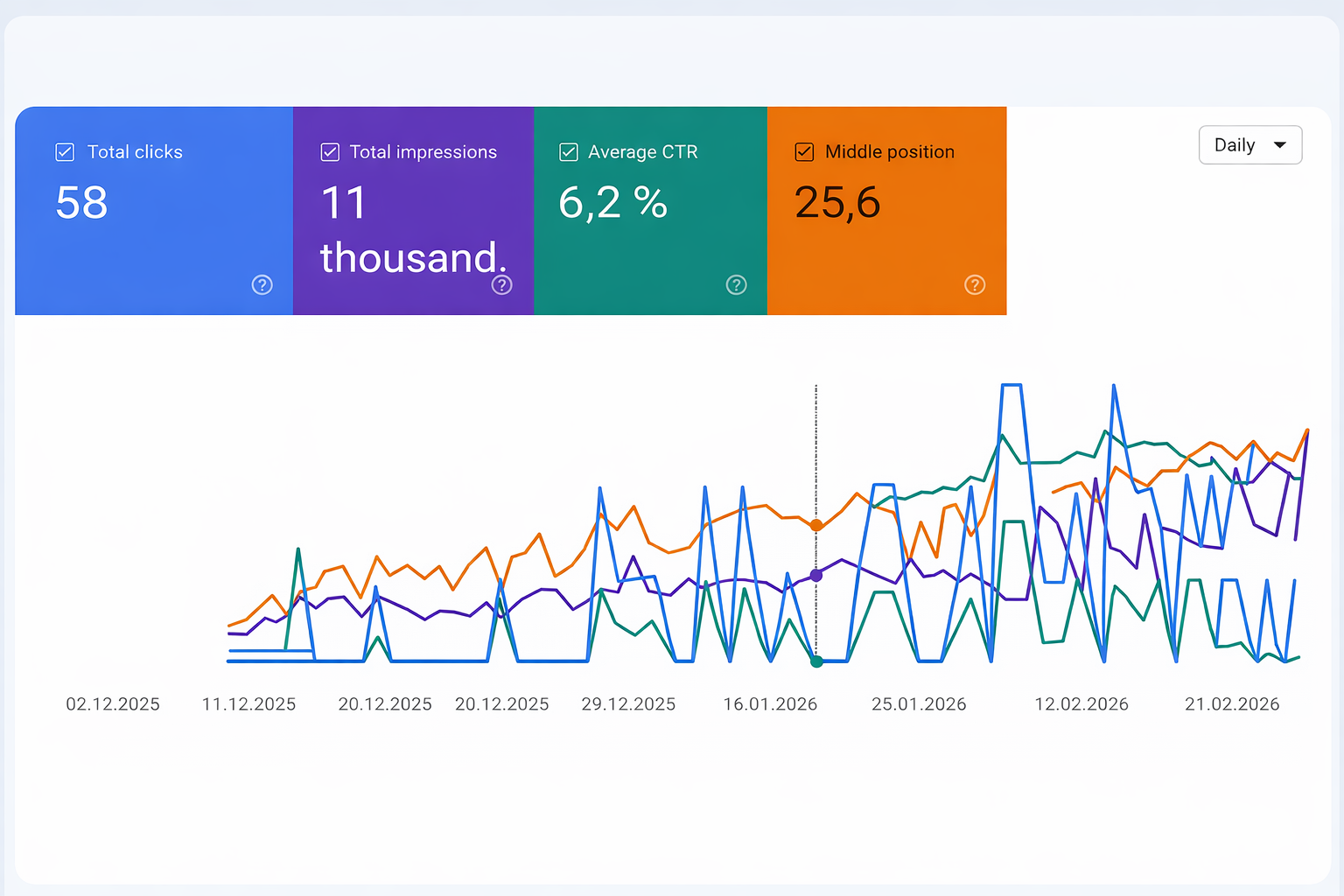
We’re not “claiming” results. We show Search Console signals:
query examples, language/country distribution, and performance trends. Any sensitive data can be blurred — the signal is still verifiable.
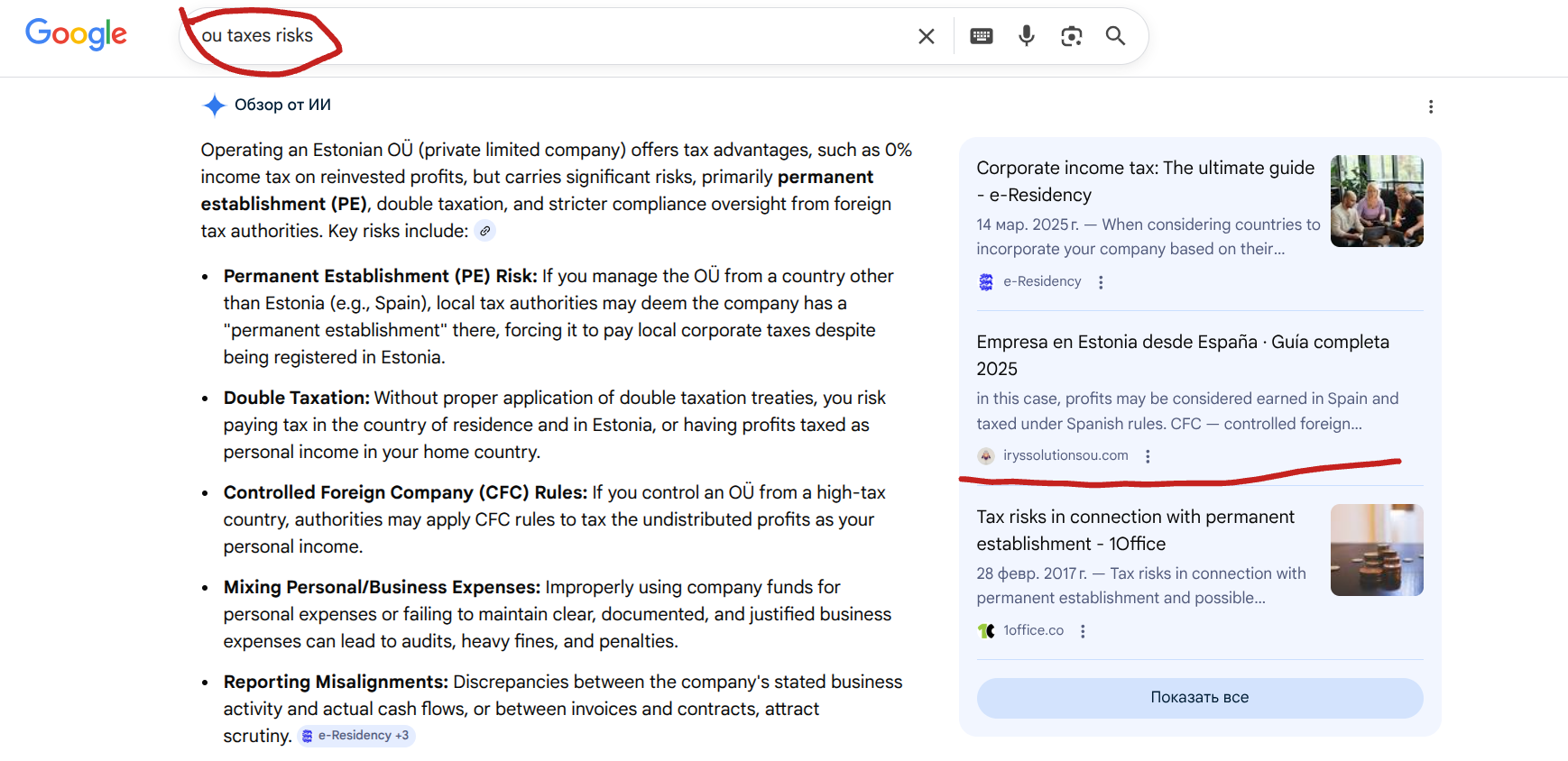
Google is not just ranking a page — it references it inside an AI-generated answer. That requires structured, reliable content in a niche where Google is strict.
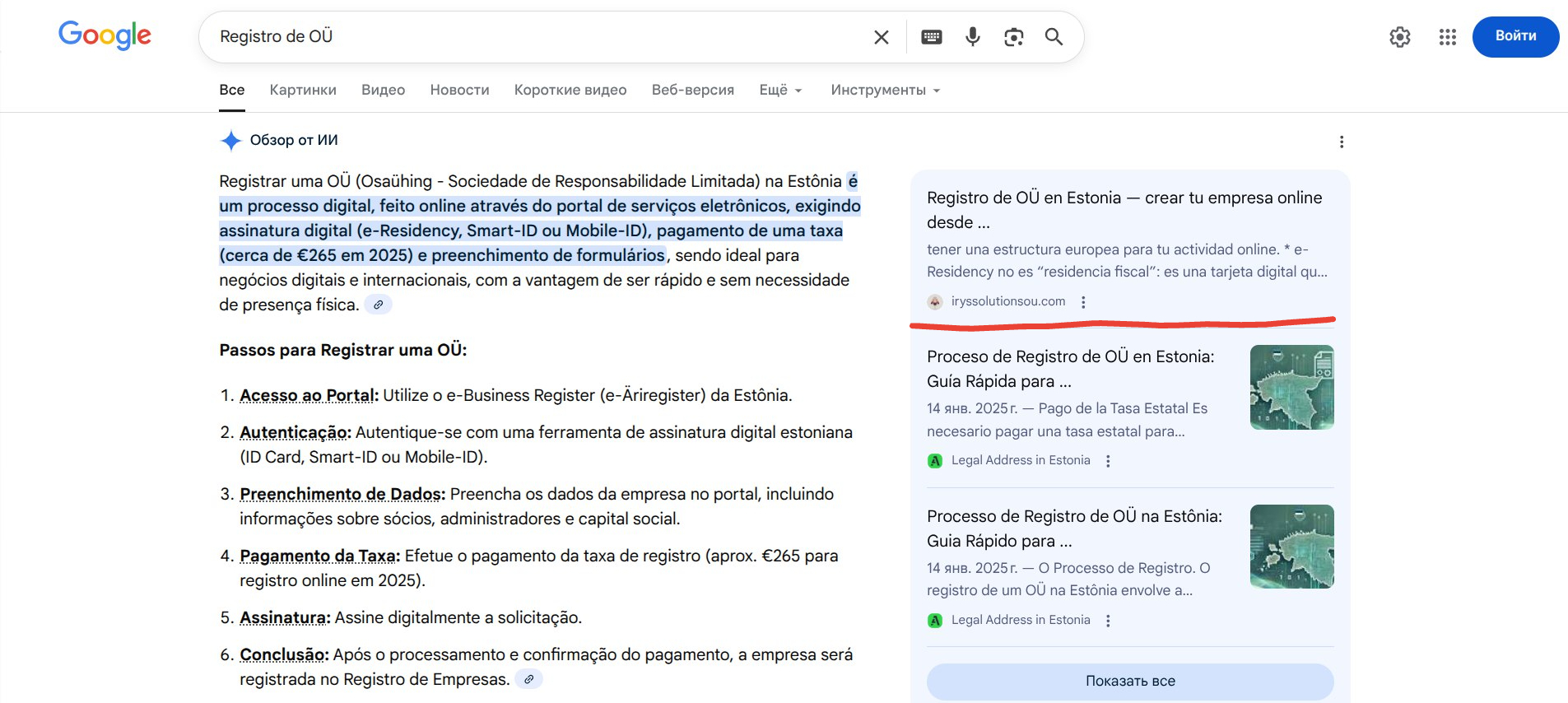
A single screenshot can be “luck”. Multiple languages reduce that excuse. This is what real topical authority looks like.
Why this niche is hard (and why generic SEO fails)
Accounting, tax, legal, and compliance are regulated topics. Google is stricter here than in “easy” niches.
Thin blog posts don’t build trust. Random backlinks don’t fix structure. And generic translations don’t match intent.
If you want B2B leads in professional services, you need a site that looks like a reliable entity — not a content farm.
What we did NOT do
- No backlink spam. We didn’t buy “packages” or build fake authority.
- No AI-generated filler. Volume without intent is noise, and Google filters it aggressively in regulated niches.
- No city-domain clones. Multiple thin sites dilute trust and damage brand signals.
- No keyword stuffing. Google understands context; repetition is not strategy.
What we built (the framework)
1) Cluster architecture (service-first, not blog-first)
We started with service pages targeting commercial intent, then supported them with tightly related informational pages.
This is the opposite of the typical mistake: publishing dozens of random posts and hoping “traffic” becomes revenue.
2) Multilingual intent mapping (EN ≠ RU ≠ ES)
We didn’t translate 1:1. We aligned language with buyer intent:
English searches often indicate service demand, Russian searches often indicate risk analysis and decision-stage research,
and Spanish searches are frequently cross-border comparisons (EU founders operating from Spain).
3) AI-compatible content formatting
We used a structure that works for both humans and Google’s systems:
clear definitions, direct answers, tables where needed, consistent headings, and FAQ blocks.
This reduces ambiguity — and ambiguity is what kills visibility in AI-driven SERPs.
4) Entity and trust signals
Professional services require credibility. We reinforced the entity with consistent messaging, clear service scope,
and a site structure that communicates: “this is a real provider, not a content project”.
Why it worked (2025+ Google reality)
Google increasingly builds answers. If your site is not structured as a reliable source, you are not included.
In professional services, “included” beats “ranked”. Because AI Overviews can take attention before the user scrolls to organic results.
If you sell professional services in the EU: we can tell you what cluster to build first and what signals to track — in plain terms.
Send us your niche + target countries + current languages. We’ll give you a practical 30-day execution roadmap
(pages to build, queries to target, and what to measure in Search Console).
Continue the series (next steps)
- Article 2 — SEO for Accounting Firms: What Actually Works (service-intent structure)
- Article 3 — Multilingual B2B SEO: Intent Mapping + Hreflang (how to do it properly)
- Article 4 — Optimizing for Google AI Overviews in Regulated Niches (format + evidence)
- Article 5 — Building Topical Authority Without Spam (cluster + internal linking)
FAQ
Is this replicable outside accounting (legal, tax, compliance)?
Yes. The framework is designed for professional services where Google requires higher trust and clearer structure.
Do we need to disclose exact traffic and click numbers?
No. Search Console screenshots can be anonymized while still proving query intent, multilingual signals, and trend direction.
How fast can we see initial signals?
It depends on niche and baseline. But you should see measurable Search Console signals once architecture + intent alignment are correct.
Do you rely on backlinks?
We use links as a supporting factor, not as a substitute for structure and content reliability — especially in regulated niches.
Want Google (and its AI) to treat your site as a reliable source?
If you’re selling professional services and tired of “SEO advice” that doesn’t produce qualified leads,
we’ll give you a practical plan: what to build first, what to measure, and what to ignore.