

B2B SEO for Professional Services — Article Series
This article is part of our B2B SEO for Professional Services series,
where we break down real SEO strategies used for EU professional service firms.
Articles in the series:
Case Study ·
SEO Architecture ·
Multilingual SEO
Multilingual SEO for Professional Services: Why Translation Is Not Enough in EU Markets
Many EU firms “go multilingual” by translating pages word-for-word. That looks international, but it often kills relevance.
This article shows how multilingual SEO for professional services works in practice: different languages often mean different client intent.
Series context
This is Article 3 in our B2B SEO for Professional Services series.
Article 1 showed a real case with evidence. Article 2 explained service-first architecture.
Article 3 explains how multilingual SEO for professional services multiplies demand when language matches intent.
Client reference (real brand, real domain)
Example used across the series: Irys Solutions (Estonian accounting & corporate services).
Public domain (linkable): iryssolutionsou.com.
Why multilingual SEO is not “translation SEO”
Most companies assume multilingual SEO is simple: translate the site into multiple languages and “cover Europe”.
That approach often fails in professional services because Google is not ranking languages — Google is ranking relevance.
And in the EU, different languages frequently represent different stages of the client decision process.
TL;DR
In EU professional services, different languages often represent different stages of the client decision process.
- English — service demand
- Russian — research stage
- Spanish — cross-border comparison
Multilingual SEO for professional services works best when each language answers a different question.
The simple analogy: one business, three entrances
Think of your firm as one office with three entrances on three different streets.
Each street brings a different type of client:
- people ready to hire,
- people comparing options,
- people still researching risks and rules.
Multilingual SEO for professional services works the same way: each language is an entrance.
The mistake is treating every entrance as if it brings the same person.
What different languages usually mean in EU B2B professional services
English often means “I need a provider”
Common English searches tend to be service-demand queries:
accounting services estonia, bookkeeping estonia, payroll services estonia.
In multilingual SEO for professional services, English pages typically convert when services are clear and easy to compare.
Russian often means “I’m evaluating risk and cost”
Russian queries often indicate decision-stage research: taxes, compliance, pricing, consequences.
Translating English service pages word-for-word into Russian usually misses what the user is actually asking.
Multilingual SEO for professional services works when Russian pages answer the “should I do this?” questions.
Spanish often means “cross-border comparison”
Spanish queries in EU professional services often come from founders operating from Spain and comparing jurisdictions.
This layer bridges research into service demand — and it’s a major growth lever when built intentionally.
Again: multilingual SEO for professional services is not about translation, it’s about matching intent.
Why word-for-word translation fails
Here’s the practical issue: these are not the same search, even if the topic “looks” the same.
- English: accounting services estonia (ready to hire)
- Russian: taxes in estonia for companies (risk + decision)
- Spanish: empresa en estonia impuestos (comparison + context)
Multilingual SEO for professional services starts working when you stop translating words and start matching demand.
What we do instead (business-first approach)
Instead of “translate everything”, we build language layers around client intent:
- English pages lead with services and pricing logic.
- Russian pages lead with risk, rules, and decision clarity.
- Spanish pages lead with cross-border comparisons and “how it works from Spain”.
All paths still lead back to the same service pages. That’s the core of multilingual SEO for professional services.
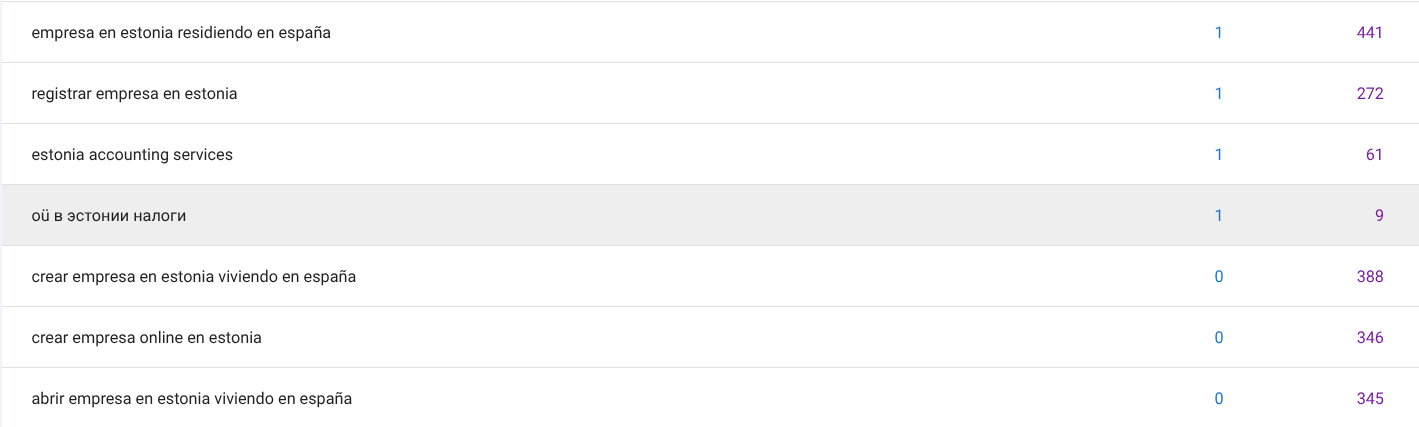
Insert a Search Console view showing language/country distribution and example queries.
Blur exact clicks/impressions if needed — the key is the multilingual query mix and intent type.
Why Google rewards this in professional services
In regulated niches (accounting, tax, legal, compliance) Google rewards clarity and entity trust.
A multilingual site built on intent looks like a real provider — not a translation project.
That’s why multilingual SEO for professional services can outperform bigger sites built on generic content.
Why this matters in AI-driven search
Google increasingly synthesizes answers. If your site isn’t structured as a reliable provider, you won’t be included.
Multilingual SEO for professional services improves inclusion because it demonstrates topic coverage and audience understanding across markets.
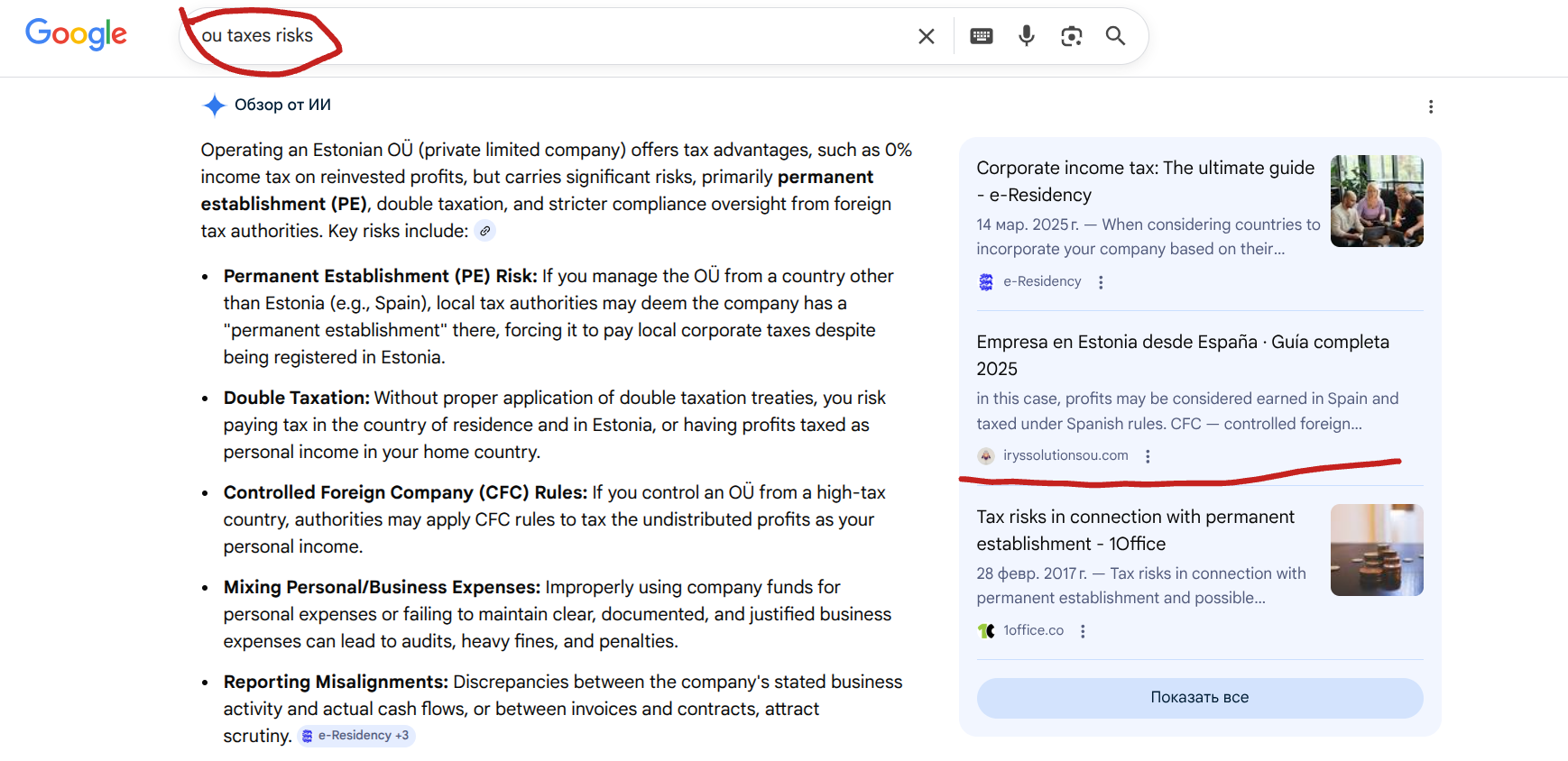
Use an AI Overview screenshot where the client is cited as a source.
This supports the claim that the site is not just ranking — it is being referenced in AI answers.
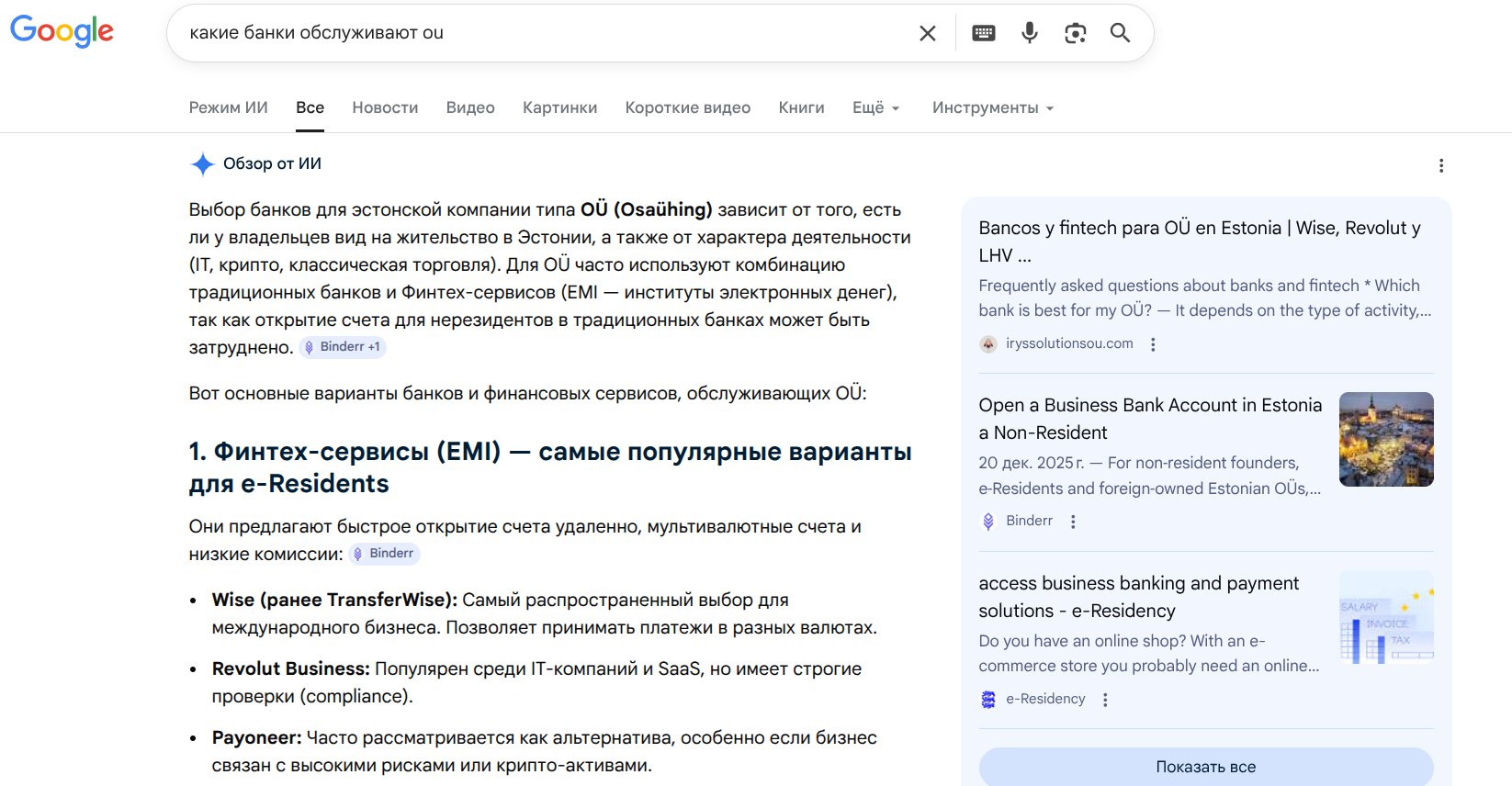
Add a second AI Overview screenshot from a different language (RU or ES).
Multiple languages reduce the “random luck” argument and strengthen the case for multilingual SEO for professional services.
Implementation basics (multilingual SEO for professional services)
1) Services stay the core
Service pages are the commercial anchor. Multilingual SEO for professional services fails when blog posts become the center and services are hidden.
2) Languages support the service cluster
Informational pages exist to support service intent — not to generate random “traffic”.
In multilingual SEO for professional services, query mix matters more than page count.
3) Hreflang is required (and must reflect real audiences)
Hreflang tells Google which language version to show. In EU markets, getting this wrong causes dilution and wrong-SERP impressions.
4) Internal linking must stay consistent
Each language layer should reinforce the same services and the same entity. Orphan pages weaken authority and conversion paths.
Common mistakes that kill multilingual SEO in professional services
- 1:1 translations. Translating words is not translating demand.
- Hidden services. If users need three clicks to find what you sell, Google gets a weak signal too.
- Too many generic posts. Regulated niches punish thin, repetitive content.
- No jurisdiction clarity. “EU accounting” without scope is a trust killer.
- No linking logic. Orphan pages dilute relevance and weaken conversion paths.
If you sell professional services in the EU: we’ll tell you what to build first and what to measure — in plain terms.
Send your niche + target countries + current site languages. We’ll reply in writing with a practical
30-day multilingual SEO for professional services roadmap: pages to build, query targets, and what to track in Search Console.
Continue the series (next steps)
- Article 1 — Real Case: 3 Languages + Google AI Overviews (Proof)
- Article 4 — Google AI Overviews in Regulated Niches: How to Earn Citations
- Article 5 — Topical Authority Without Spam: The Internal Linking System
Still reading? Run a quick check.
WEBSITE CLIENT DIAGNOSIS
Your Website Gets Traffic. But Does It Actually Generate Clients?
Send your website and receive a written diagnosis explaining exactly why it doesn’t generate clients.
- why your website doesn’t generate leads
- where potential clients actually search
- what competitors are doing differently
- what should be fixed first
Written response within 12 hours. No calls required.
FAQ
Do we need to translate every page?
No. In multilingual SEO for professional services, you translate and build only what aligns with real search demand and intent.
Is multilingual SEO necessary in Europe?
Often yes. EU B2B markets operate across languages. Ignoring that reduces demand coverage and weakens growth potential.
Can this work for legal and compliance firms?
Yes. The more regulated the niche, the more structure and entity clarity matter — especially across languages.
Do you require calls?
No. We work async: written brief and written roadmap via WhatsApp.
Want multilingual SEO for professional services that brings commercial queries?
If your multilingual site is built like a translation project, Google will treat it like one.
We’ll help you build a service-first multilingual structure that produces qualified EU B2B intent.
No calls — written roadmap via WhatsApp.